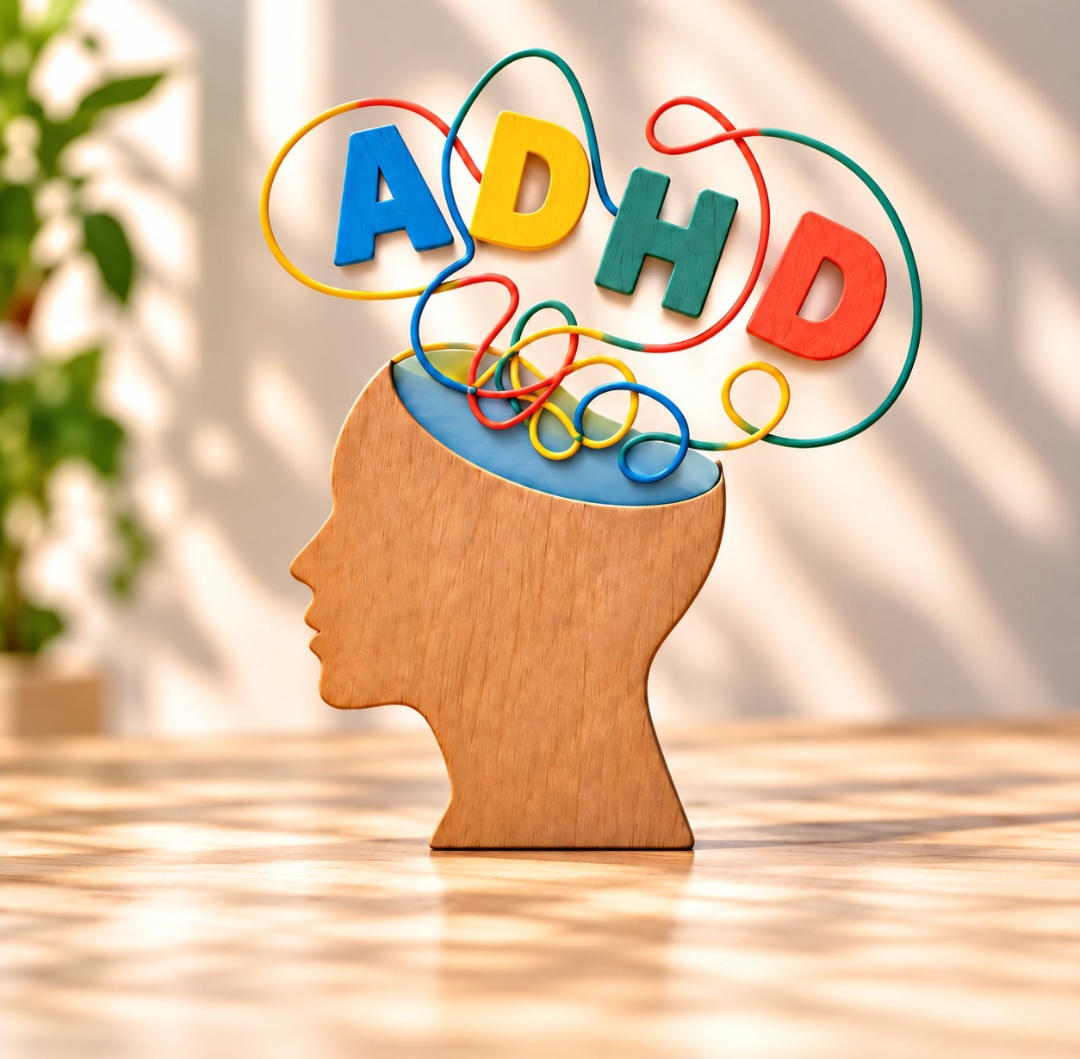
ADHD Is Not Just an Attention Difficulty; What Is Attention-Deficit/Hyperactivity Disorder Really?
"If he can play on the computer for hours, how can he not concentrate in class?", "She keeps putting things off until the last minute", "I know exactly what I need to do, but I just can't get started".
Statements like these reflect common perceptions of attention-deficit/hyperactivity disorder, but also the gap between what is visible from the outside and the difficulty the person experiences inside.
ADHD is a neurodevelopmental disorder that affects the regulation of attention, impulse control and activity level. For many, it is also associated with difficulties in executive functions, which affect organization and everyday conduct.
It does not stem from laziness, a lack of intelligence or an absence of desire to succeed. To understand it, it is important to recognize the mechanisms behind the behavior.
What Is ADHD and How Does It Manifest?
ADHD, attention-deficit/hyperactivity disorder, is characterized by a persistent pattern of inattention and/or hyperactivity and impulsivity that is inconsistent with developmental stage and impairs functioning. The disorder can manifest in three main presentations:
- ADD - predominantly inattentive presentation Difficulty sustaining attention, a tendency toward distraction, forgetfulness, losing things and difficulty with organization.
- ADHD - predominantly hyperactive-impulsive presentation Increased movement, difficulty waiting, quick reactions without thinking and difficulty regulating activity.
- Combined type Significant characteristics from both groups.
Not every person with ADHD is hyperactive, and not every difficulty concentrating indicates an attention disorder.
A question for reflection
Do I recognize an attention disorder only by outward behavior, or do I also take into account difficulties that are not visible?
Executive Functions; When It Is Hard to Turn Intention into Action
Executive functions are a set of cognitive abilities that allow us to plan, organize, initiate tasks, inhibit responses and monitor behavior. Many people with ADHD have difficulties in these areas. For example, a student may understand the material well but struggle to submit an assignment on time. An adult may know they need to pay a bill but put it off again and again.
The difficulty is not necessarily in understanding the task, but in managing the processes required to carry it out.
A question for reflection
Do I interpret difficulty carrying out a task as unwillingness, even when the person understands well what they need to do?
Why Is It Possible to Concentrate for Hours on One Thing and Not on Another?
One of the confusing phenomena in ADHD is the variability in the ability to sustain attention.
A person may struggle to concentrate on a routine task yet be absorbed for hours in an activity that particularly interests them.
This state is sometimes described as "hyperfocus", that is, deep absorption in an activity to the point of difficulty disengaging from it.
This does not contradict the presence of an attention disorder. It demonstrates that the ability to direct and regulate attention is not uniform in every situation.
Interest, novelty, immediate reward and urgency may affect the level of engagement in a task.
A question for reflection
In which situations is my attention mobilized easily, and what is different about them compared with the tasks I struggle with?
Time Perception; Why Does Everything Happen at the Last Minute?
Many people with ADHD describe difficulty estimating how long a task will take, preparing in advance or sensing an approaching deadline. The non-diagnostic term "time blindness" is sometimes used to describe these difficulties. The result may be lateness, procrastination, last-minute overload or difficulty transitioning between activities.
It is important to understand that procrastination is not always a conscious choice. Sometimes it is related to difficulty initiating action, estimating effort or managing priorities.
A question for reflection
Do I mainly struggle to carry out tasks, or to estimate when to start and how much time to devote to them?
ADHD and Emotional Regulation; The Connection Less Often Discussed
Some people with ADHD also have difficulties with emotional regulation, such as high reactivity to frustration, difficulty calming down after a conflict or a tendency toward rapid emotional reactions. These difficulties are common among people with ADHD, but are not in themselves considered a core diagnostic criterion of the disorder. A child may react intensely when an enjoyable activity ends, and an adult may struggle to recover from criticism or disappointment. At the same time, it is important not to attribute every emotional difficulty to ADHD, since anxiety, depression, trauma and other factors may affect emotional responses.
A question for reflection
Do I relate only to the visible behavior, or do I also try to understand the regulatory difficulty that may lie behind it?
Dopamine, Motivation and the Reward System
Dopamine is a neurotransmitter involved, among other things, in processes of motivation, learning from reward and behavioral control.
Research points to the involvement of brain systems related to dopamine and other neurotransmitters in ADHD, but this is not a disorder that can be simply explained as a "dopamine deficiency".
For some people with ADHD, tasks whose reward is distant or that do not arouse immediate interest may be especially challenging. Therefore, breaking a task into stages, creating short-term goals and providing timely feedback may help with persistence.
A question for reflection
Does the way I organize tasks help me maintain motivation, or do I rely only on willpower?
How Does ADHD Affect Self-Image?
The impact of ADHD is not limited to academic or functional difficulties.
Children and adults coping with the disorder may hear remarks over the years such as "You're not trying", "You're not listening again" or "If you only wanted to, you would succeed". When such experiences recur, a person may internalize a negative view of their abilities and develop feelings of failure, shame or inadequacy. Sometimes it is precisely the gap between cognitive abilities and actual performance that is a significant source of frustration.
Identifying the difficulty and providing a suitable explanation can help reduce self-blame and develop effective ways of coping.
A question for reflection
Which messages about my abilities, or my child's, have over the years become part of the self-image?
How Is ADHD Diagnosed?
Diagnosing ADHD is a clinical process based on examining the symptoms, developmental history and their impact on functioning in different life settings. The diagnosis includes assessing the duration of the difficulties, their appearance in childhood and the degree of functional impairment, alongside examining other possible explanations.
Questionnaires and computerized tools, such as the MOXO assessment, may provide additional information about attention and performance characteristics, but cannot on their own establish or rule out a diagnosis.
It is important to distinguish between ADHD and attention difficulties arising, for example, from lack of sleep, anxiety, depression or learning disabilities.
A question for reflection
Do the difficulties I notice appear over time and in different situations, or mainly in certain periods and circumstances?
What Can Help in Coping with ADHD?
Effective coping begins with understanding the person's individual profile, since the disorder does not manifest in the same way in everyone.
Treatment may include parent guidance, behavioral interventions, CBT adapted for ADHD, adjustments in the environment and in the educational or occupational setting, and, where appropriate, medication. Tools such as external reminders, breaking down tasks, fixed routines and reducing distractions can support functioning.
The aim is not to change the person's personality, but to develop skills and strategies that will enable them to cope with the difficulties and realize their abilities.
A question for reflection
Which adjustments to my environment and ways of managing could reduce everyday effort and allow me to function better?
Understanding the Person, Not Only the Disorder
ADHD does not define a person's full range of abilities, personality or future. Alongside the difficulties, every person has strengths, interests, skills and personal resources that are important to identify and nurture.
A professional understanding of ADHD makes it possible to move from judging behavior to understanding the mechanisms behind it, and to choose ways of coping that are tailored to the person and not only to the diagnosis.
A question for reflection
How would my attitude toward myself or someone close to me change if I saw the difficulties as an expression of functioning that requires support, rather than evidence of a lack of ability or effort?
This article is intended for information and reflection and is not a substitute for individually tailored professional care.
More Articles on ADHD
- Women and ADHD; Why Might Attention Difficulties Be Identified Late?Read article
- ADHD in Adolescence; When Difficulties Change with AgeRead article
- Anxiety or Trauma; Why Can the Symptoms Look Similar to ADHD?Read article
- "He Can When He Wants To": One of the Biggest Myths About Children with ADHDRead article
- ADHD and Anger Outbursts; What Is the Connection Between Attention-Deficit/Hyperactivity Disorder and Emotional Regulation?Read article
- ADHD During Relocation; When Moving to Another Country Meets Difficulties with Organization, Social Life and MotivationRead article
- The MOXO Test; What Does It Measure, What Can We Learn from It, and When Should We Seek a Diagnostic Evaluation?Read article